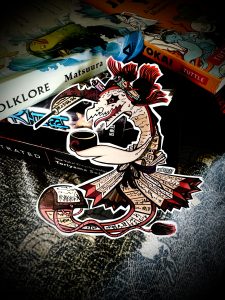
• About this Yokai: Abandoned sacred scrolls containing ancient holy sutras & knowledge which has long faded from public conscious. After being ignored and left to gather dust on a shelf for decades, these rolled papers sprang to life as a vengeful tsukumogami in the shape of a paper dragon. Now it furiously taps on a ringing bowl in outrage towards the foolish fraud who abandoned its teachings & raised curses; utterly wasting the knowledge they contained….
• Origin: Another tsukumogami first written and illustrated about by Toriyama Sekien in his “Gazu Hyakki Tsurezure Bukuro” (1784). The illustration shows makimono (ancient sutra scrolls and books) which have magically taken on the form of a dragon. Through a ripped-page-jaw rolls a lolling tongue a hooked nose, an eye bursts from a written page. It wears two scrolls with frayed tassels on his head creating a pair of horns and a wild mane. Another scroll resembling a monks robes are tied around the middle of its slender serpent-like, paper-thin body. In one of its “hands” it holds a ringing bowl, the other a stick. The room is a mess, there are scrolls & books about treasure (see: Takaramono), files and a flipped table with scrolls strewn all about the messy floor.
Toriyama’s included passage goes as follows:
“That a holy book of sutras came to look this way is because they are the sutras abandoned by the monk Shubin, whose curses and poison were revisited upon him. So I dreamed” (Translation: Japandemonium Illustrated. 2017.)
Today Kyorinrin is often summarized as a ‘spirit of knowledge’ or a ‘yokai born from books which have been left unstudied.’ But saying ‘Kyorinrin is a yokai of forgotten knowledge’ feels a bit ironic, as most of the online sources I’ve found about this yokai will often entirely omit the legend which likely inspired it!
The monk mentioned by Toriyama was Shubin Sozu, a monk of Sai-ji, a temple to the west of Kyoto. He was the bitter rival to the far more successful Shingon monk, Kūkai (More famously known by his posthumous name Kōbō Daishi) of To-ji, a temple to the east of Kyoto. The two’s famous magical duel was retold as an anecdote in the Taiheiki, a collection of stories the period of 1319 to 1367, often with a Buddhist slant. The chapter titled “The Matter of the Garden of Divine Waters“ recounts the then Emperor’s restoration of the Kyoto palace garden in the 1330s as a sacred site to a rain bringing dragon. The moral of said legend also directly quotes the famous Lotus Sutra. “Spells and poisonous medicines return to their makers” This is the same quote Toriyama references in Kyorinrin’s description.
The Legend goes a bit like this:
“Long ago in the Heian period (794–1185 CE), Kūkai, the Emperor’s religious advisor and head priest of To-ji temple had to leave Japan for some very important religious business. To provide the Emperor with still divine protection in his absence, Shubin of Sai-ji temple stepped in his place. But Shubin wanted more than to be just a substitute in the emperor’s court.
To win favour with the Emperor, Shubin used magic to perform various favors for him such as magically heating & cooling the Emperor’s bath water. The emperor marveled and was astonished by such acts and Shubin quickly gained the emperor’s trust.
When Kūkai returned, he and the emperor conversed about his travels and what had happened while he’d been away. It was then the Emperor told Kukai of all the wonderful and convenient uses Shubin had for his magic.
To this, Kukai laughed and told the Emperor that frankly Shubin shouldn’t be able to cast such spells as a holy monk! He also added that Shubin wouldn’t do such magic while in his presence. And so, the Emperor decided to test Shubin’s virtues.
Kukai hid himself nearby while the Emperor asked Shubin to heat his cold medicinal brew in a bowl. Shubin tried heating the bowl with his usual magic but failed. The Emperor called a servant to bring over some boiling water to be used instead. Then the Emperor said the bowl was too hot to hold onto and asked Shubin to cool it using his magic, but yet again Shubin failed! Finally Kūkai revealed himself from behind a sliding door and told Shubin off for his wicked practices.
Shubin was not about to take this disgrace lying down and decided that his revenge would extend over the Emperor’s entire kingdom with a spell that would capture all of the dragon kings across Japan in a water jar. As dragons are the ones to create rain, this spell would cause a terrible drought that would last well-over the entire summer!
Or at least, it would have if Kūkai hadn’t countered the spell by praying for rainfall. He summoned ‘Zennyo Ryūō’, A young dragon queen from the far north in India, to bring rainfall across the land, he then told the emperor to have a grand lake built in the garden in front of his palace as tribute. Zeenyo heard Kukai’s prayers and arrived as a golden dragon riding a 9ft long white snake! It rained across the country for nearly a week, swiftly bringing the drought to an end. People rejoiced and The Emperor’s reverence for Kūkai & his sects teachings became stronger than it ever had been!
Of course, Shubin was furious at this. He shut himself in the western temple and created a north-facing altar where he began to honor wrathful god Gundari Myo-o and resolved to end Kūkai’s life praying for a deadly curse. Though he did not realize it, Shubin had already failed! For in that very moment, Kūkai was entranced in meditative prayer and had erected a shrine to the bright monarch Dai Itoku Myo-o, effectively countering Shubin’s curse.
Kūkai also had the foresight to spread rumors of his own death. The news of which created great sorrow amongst the people- nobles, farmers and monks alike wept bitter tears.
Shubin heard their tears and was overjoyed. He tore apart his altar believing that his prayers for Kukai’s death where a success. And then Shubin was suddenly struck blind. His mind and body were stricken with anguish and blood streamed from his eyes and nose. He fell over dead where his altar once stood. His own curse had been reflected upon himself ten-fold! Truly, this was a revelation of the truth of the golden teaching “Spells and poisonous medicines return to their makers.”
And since that day the Western Temple was destroyed while the Eastern Temple flourished!”
…An alternate ending and my personal favourite version of the events comes from Yatori Jizo shrine. Instead of praying for curses, Shubin attempts an assassination on Kukai with a long bow on a rainy evening near Rajōmon Gate only to have the arrow stopped by a mysterious monk in black- supposedly a statue of Jizo bodhisattva that came to life and protected him. This small statue is still venerated at the Yatori Jizo shrine located near the ruins of the Rajomon Gate in Southern Kyoto.
Regardless of how the story ends, it’s said that these events are what caused Sai-ji temple to fall into ruin. Today, a marker still stands where the ancient temple once stood. To-ji temple of course still flourishes to this day.
…So after all of those magical shenanigans, god battling, and ruination, it seems only logical that the temple’s abandoned sutras would eventually have become Tsukumogami! (Or at least, that’s seemingly what Toriyama Sekien seems to have imagined/implied.)
• The Antiques in Question:
In addition to the makimono (scrolls) that compose its body, Kyorinrin also carries an orin (ringing bowl) which is where it gets part of its name. “Rin-rin” can mean “fierce” but it is also -as you might guess- an onomatopoeia for “ringing” (It seems Toriyama was feeling punny again, as he often was with a number of his yokai.) Could the ringing bowl also be a visual nod to the medicine bowl that Shubin re-heated with magic? Its difficult to say for certain!
Curiously, the orin rarely seems to appear in interpretations of Kyorinrin despite it being where the yokai gets its name from. (That includes Toriyama’s verse which makes no mention of the bowl!) I’d suppose it makes enough sense, given that the main body of this yokai is made of scrolls, but given that the sound of the bowl is what gives this yokai it’s name; it feels like a pretty important part of this yokai to overlook…
[an orin ‘ring gong’ bowl & stick like the one kyorinrin is holding. These singing bowls would be struck during prayer for meditative reasons similar to a mokugyo or “wooden fish” (See also Mokugyo Daruma.) ]
One other noteworthy thing about the illustration which is often overlooked is that one of the books on the ground in front of kyorinrin is decorated with lucky emblems known as “Takaramono”. The crisscrossed scrolls are the sacred makimono, scrolls of wisdom, which belong to the gods Jurojin & Fukurokuju. The orb with a flame is a sacred “Hoju”. These auspicious emblems are relevant to the Shichifukujin (Seven lucky gods) who make an appearance at both the beginning and end of Tsurezure Bukuro! The treasures themselves can also be seen on the second to last page of the book being carried on the back of an elephant, presumably being loaded aboard the Takarabune (Treasure boat) for new years celebrations!
Though Toriyama does not say it outright, many of the tsukumogami in Tsurezure Bukuro are seemingly Takaramono inspired. Fukuro-Mujina- a disguised tanuki carrying a bag of badgers- could represent Hotei’s Kanebokuro– the bag of plenty. Kinutanuki– a tanuki disguised as a luxurious bolt of cloth- likely represent the royal brocades, Orimono. Mino-waraji – a rain cloak made of straw which became lost in the snow and took on the appearance of an old man – may represent the invisibility granting straw cloak, Kakuremino. The list goes on. So, It doesn’t feel like that much of a stretch to say that perhaps Toriyama got the idea for a scroll yokai from both the Takaramono’s makimono scrolls of wisdom as well as Shibun’s Legend. Perhaps these yokai are transformed versions of the lucky treasures?
[Picture of ‘the treasures of the takaramono’ from Hokusai’s manga]
[Art Sticker by @samkalensky (Yo, that’s me!) Editing by @cattype (I’m also here!) Follow and support our works on Patreon for many more! Hopefully my contemporaries dont mind a cameo/me showing off my yokai library in the photos, I’d highly recommend each book shown! :3c]
Additional information
Title
Default Title
Reviews
There are no reviews yet.
Be the first to review “Kyo-rin-rin – [Yokai|Tsukumogami]” Cancel reply

![Kyo-rin-rin - [Yokai|Tsukumogami]](https://samkalensky.com/wp-content/uploads/2026/03/IMG_4641-scaled.jpeg)
![Kyo-rin-rin - [Yokai|Tsukumogami] - Image 2](https://samkalensky.com/wp-content/uploads/2026/03/img_4648-1-scaled.jpeg)
![Kyo-rin-rin - [Yokai|Tsukumogami] - Image 3](https://samkalensky.com/wp-content/uploads/2026/03/img_4650-2-scaled.jpeg)
![Kyo-rin-rin - [Yokai|Tsukumogami] - Image 4](https://samkalensky.com/wp-content/uploads/2026/03/img_4653-1-scaled.jpeg)
![Kyo-rin-rin - [Yokai|Tsukumogami] - Image 5](https://samkalensky.com/wp-content/uploads/2026/03/img_4675-scaled.jpeg)
![Kyo-rin-rin - [Yokai|Tsukumogami] - Image 6](https://samkalensky.com/wp-content/uploads/2026/03/img_4651-scaled.jpeg)


![Mokugyo Daruma - [Yokai/Tsukumogami]](https://samkalensky.com/wp-content/uploads/2026/03/1766442974160-h5ik6doj1i-324x324.jpg)
![Tesso - 鉄鼠 - [ Yokai | Onryo ]](https://samkalensky.com/wp-content/uploads/2026/03/IMG_1045-324x324.jpeg)
![Hossumori - [Yokai|Tsukumogami]](https://samkalensky.com/wp-content/uploads/2026/03/1766198851984-48w6agsvxku-324x324.jpg)
![Kyo-rin-rin - [Yokai|Tsukumogami]](https://samkalensky.com/wp-content/uploads/2026/03/IMG_4641-324x324.jpeg)
Reviews
There are no reviews yet.