
![Choku-boron - [Yokai|Tsukumogami]](http://samkalensky.com/cdn/shop/files/IMG_3225_{width}x.jpg?v=1770577076)
![Choku-boron - [Yokai|Tsukumogami]](http://samkalensky.com/cdn/shop/files/IMG_3223_{width}x.jpg?v=1770577076)
![Choku-boron - [Yokai|Tsukumogami]](http://samkalensky.com/cdn/shop/files/IMG_3220_{width}x.jpg?v=1770577076)
![Choku-boron - [Yokai|Tsukumogami]](http://samkalensky.com/cdn/shop/files/IMG_3217_{width}x.jpg?v=1770577076)
![Choku-boron - [Yokai|Tsukumogami]](http://samkalensky.com/cdn/shop/files/pasted-media-1770502299265-c9wapz3_6e576aa1-3d7c-4aad-884f-f9022d645887_{width}x.png?v=1770577076)
![Choku-boron - [Yokai|Tsukumogami]](http://samkalensky.com/cdn/shop/files/IMG_3231_{width}x.jpg?v=1770577076)
![Choku-boron - [Yokai|Tsukumogami]](http://samkalensky.com/cdn/shop/files/IMG_3221-1_{width}x.jpg?v=1770577076)
![Choku-boron - [Yokai|Tsukumogami]](http://samkalensky.com/cdn/shop/files/IMG_3225_530x@2x.jpg?v=1770577076)
![Load image into Gallery viewer, Choku-boron - [Yokai|Tsukumogami]](http://samkalensky.com/cdn/shop/files/IMG_3225_1024x1024@2x.jpg?v=1770577076)
![Load image into Gallery viewer, Choku-boron - [Yokai|Tsukumogami]](http://samkalensky.com/cdn/shop/files/IMG_3223_1024x1024@2x.jpg?v=1770577076)
![Load image into Gallery viewer, Choku-boron - [Yokai|Tsukumogami]](http://samkalensky.com/cdn/shop/files/IMG_3220_1024x1024@2x.jpg?v=1770577076)
![Load image into Gallery viewer, Choku-boron - [Yokai|Tsukumogami]](http://samkalensky.com/cdn/shop/files/IMG_3217_1024x1024@2x.jpg?v=1770577076)
![Load image into Gallery viewer, Choku-boron - [Yokai|Tsukumogami]](http://samkalensky.com/cdn/shop/files/pasted-media-1770502299265-c9wapz3_6e576aa1-3d7c-4aad-884f-f9022d645887_1024x1024@2x.png?v=1770577076)
![Load image into Gallery viewer, Choku-boron - [Yokai|Tsukumogami]](http://samkalensky.com/cdn/shop/files/IMG_3231_1024x1024@2x.jpg?v=1770577076)
![Load image into Gallery viewer, Choku-boron - [Yokai|Tsukumogami]](http://samkalensky.com/cdn/shop/files/IMG_3221-1_1024x1024@2x.jpg?v=1770577076)
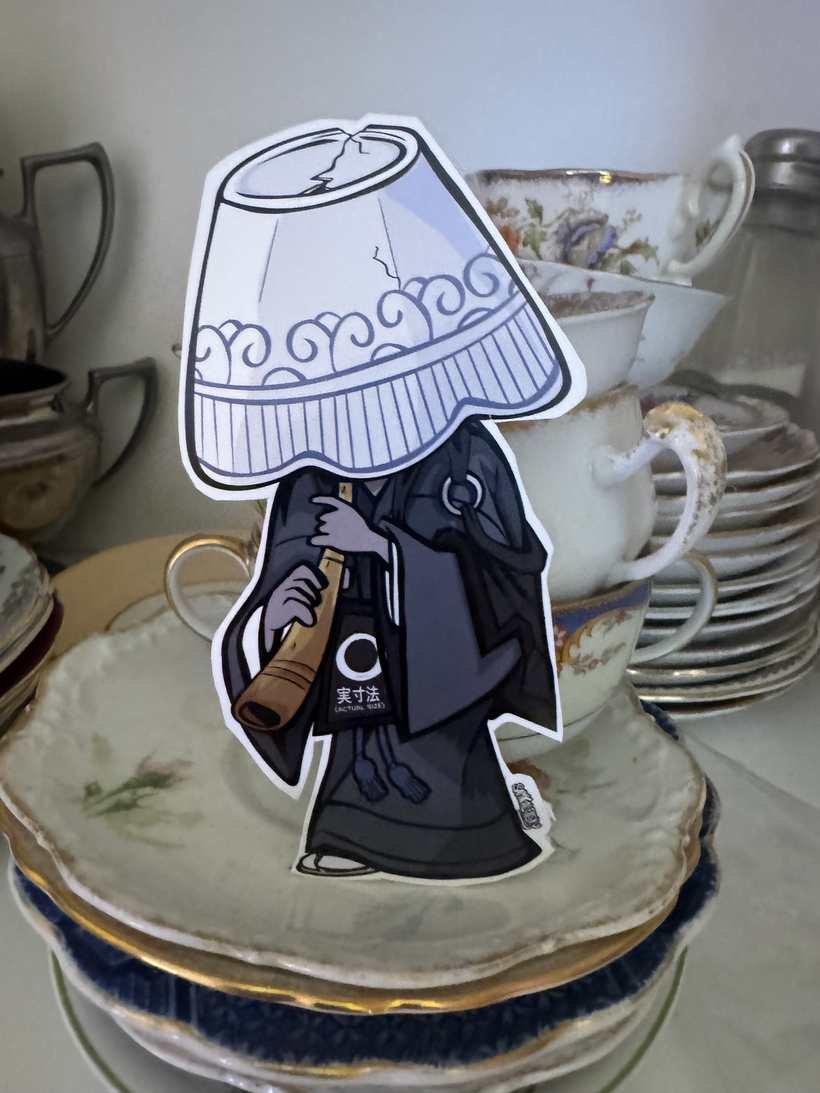
Chokuboron - 猪口暮露(ちょくぼろん) - [Yokai | Tsukumogami] - Aka: “Cupmonks."
• About this yokai: A set of miniature sake cups which were dropped, cracked and eventually became tiny tsukumogami dressed as wandering Komusō monks. Each wears a sake cup as a Tengai (basket-hat.) It’s been said, that on nights when you’ve had a bit too much to drink and are just about to nod off, these tiny monks will appear one by one- one for each drink you’ve had- They’ll parade about playing a sharp tune with their shakuhachi (long flutes) just as the Fuke-sect of Zen-Buddhist monks used to do, Perhaps they’re scolding you for over-indulging.
• Origin: Choku-boron was another one of the many Tsukumogami, first named and depicted in Toriyama sekien’s "Gazu Hyakki Tsurezure Bokuro" (1784). Toriyama’s included verse, goes roughly as follows:
“As Emperor Ming of Tang sat reading, a tiny human appeared on his desktop. The Emperor shouted; his servant declared that the creature was an ink-fairy and it disappeared. Perhaps the Choku-boron I saw in my dream are similar sorts.” - [Translation: Japandemonium 2017]

[as they appear in Toriyama Sekien’s Gazu Hyakki Tsurezure Bukuro (vol 2). [1784] - Image source: Smithsonian]
• The Antique in Question: “Choku“ are tiny porcelain or ceramic cups often used as dishes for condiments or more commonly, used for drinking tea or sake!

“Boro” has a double meaning in that it’s old slang for Komusō monks and also a homonym for a word meaning “old, tattered, patch-worked or beaten up” just like these cups are. (The same pun is later used in boroboroton's entry.) If you look closely at the illustration, many of the cups are chipped, cracked or broken. There's even one which has broken completely in half; The middle most monk’s face is also revealed! Someone seems to have accidentally dropped the box they were stored in, shattering the contents. Poor little guys.

[close up of the face.]
• History: Komusō monks are vagrant Buddhist-Zen monks who have renounced all possessions and worldly things including their egos, which is why they travel with straw baskets over their heads called “tengai” (天蓋). As they travel they perform sacred music (shuizen) with their shakuhachi flutes and chant sutras wherever they go in exchange for donations for their temples.
Unfortunately, the garb of these monks proved to be a handy disguise for anyone who wanted to travel incognito or commit crimes. Vengeful or criminal samurai would occasionally disguise themselves and hide amongst them. It’s also thought that the Komusō’s flutes were weighted and used as bludgeoning weapons like bats. For this reason, Chokuboron is said to potentially be dangerous despite its tiny size.
Although Japandemonium makes no connection to it in their book, I cannot help but notice that there's some similarity between the bit about the Emperor & the so-called “ink-fairies” to another much older Chinese story with a similar beat where in the same Emperor: Tang Ming Huang is bedridden with a fever dream and haunted by demons. A larger spirit appears and subdues the smaller demons which are causing the fever. It introduces itself to the emperor as "Zhong Kui" before vanishing. The next morning, the emperor is cured of his illness and, moved by his dream, he commands his servants to have an artist draw the healer & that it be distributed across his empire. Zhong Kui’s spirit thereafter vowed to protect the emperor and empire from evil. Zhong Kui is better known in Japan as the demon queller ‘Shōki’; who has been famously illustrated in Red-Ink and superstitiously used as an amulet for warding away diseases since ancient times across both China and Japan. It's quite difficult to say if there's any real connection here or not, at least beyond the fact that “A spirit appears before the emperor, introduces itself and vanishes.” The legend of shoki was very popular during Toriyama Sekiens time, but who can really say if this was actually reference to it or not. Ultimately I just wanted to point out that there was something of a similarity between the two stories. - Perhaps it could be said that having a fever-dream like that is kinda similar to getting drunk? (Choku are sake-cups after all!.) – Ahem!! – Anyway, do take what I've said here with a pinch of salt, Yeah?perhaps the legend changes if the teller prefers tea or not..
At this point, I must also admit I've had something of a lapse in memory! - For the life of me, I sadly cannot remember or find an exact source for where I originally read the bit about “Chokuboron (cup monks) appear in your dreams after you’ve been drinking & scold you with their noisy flutes for drinking too much.” -It does not seem to be part of the yokai’s original lore? Nor does it seem to stem from any yokai book I currently own aside from my own, Perhaps it was something that I heard from a friend? From a contemporary yokai artist? Maybe it was my younger selve's poor interpretation of Toriyama's writing? (Back when I was new to this, before I acquired Japandemonium’s better English translations of toriyamas text, I often tried to do it myself from various Japanese sources. Im not an expert, though I have always tried my very best!!) - In any case, I’m pretty sure it’s something I read somewhere… If anyone finds a match, please let me know!!
In my Second Yokai Zine, I had also mentioned Chokuboron as a footnote along with this story on the same page as "Kameosa" mostly because both yokai seemingly had to do with drinking flasks and dreams (which was technically correct!!) However, in hindsight I didn't account for the fact that Kameosa is specifically an earthen-ware flask and not a ceramic, so I suppose I got confused and conflated the two. Notably, in Toriyama Sekien’s Gazu Hyakki Tsurezure Bukuro, Chokuboron appears on the opposite page to “Seto-taisho” who also happens to have a proper ceramic seto-ware flask for a face! If I ever get around to finishing the rest of Toriyama's yokai, perhaps I’ll add this note in a future addition of my own books. --Oh well; mistakes happen. All of that said, for now let's have a drink! - Kanpai!!!
-
See also: “Seto-taisho”, "Kame-osa” “Boroboroton”
[Art sticker & Writing by @SamKalensky (yo, thats me!) Editing by @Cattype. Part of my Hyakki Yagyo Night Parade of 100 yokai sticker series. Follow & check my shop out for many more!