
![Kinutanuki - [Tanuki|Tsukumogami]](http://samkalensky.com/cdn/shop/files/D82DCA49-FE64-49DB-AC0F-346F97963015_{width}x.jpg?v=1772127404)
![Kinutanuki - [Tanuki|Tsukumogami]](http://samkalensky.com/cdn/shop/files/8453A6D9-BC1A-437A-9224-290A6388D4D1_{width}x.jpg?v=1772127404)
![Kinutanuki - [Tanuki|Tsukumogami]](http://samkalensky.com/cdn/shop/files/76BCEC13-F94F-4D5A-9C5B-EF904A74F573_{width}x.png?v=1772127404)
![Kinutanuki - [Tanuki|Tsukumogami]](http://samkalensky.com/cdn/shop/files/565735CB-FA2D-45A4-8478-593055D3123B_{width}x.jpg?v=1772127404)
![Kinutanuki - [Tanuki|Tsukumogami]](http://samkalensky.com/cdn/shop/files/30DF1D4E-8863-45DB-9477-E8E53D9460AD_{width}x.jpg?v=1772127404)
![Kinutanuki - [Tanuki|Tsukumogami]](http://samkalensky.com/cdn/shop/files/7E23624F-0A5E-4E3E-8819-8BBF9264BF6C_{width}x.jpg?v=1772127404)
![Kinutanuki - [Tanuki|Tsukumogami]](http://samkalensky.com/cdn/shop/files/D82DCA49-FE64-49DB-AC0F-346F97963015_530x@2x.jpg?v=1772127404)
![Load image into Gallery viewer, Kinutanuki - [Tanuki|Tsukumogami]](http://samkalensky.com/cdn/shop/files/D82DCA49-FE64-49DB-AC0F-346F97963015_1024x1024@2x.jpg?v=1772127404)
![Load image into Gallery viewer, Kinutanuki - [Tanuki|Tsukumogami]](http://samkalensky.com/cdn/shop/files/8453A6D9-BC1A-437A-9224-290A6388D4D1_1024x1024@2x.jpg?v=1772127404)
![Load image into Gallery viewer, Kinutanuki - [Tanuki|Tsukumogami]](http://samkalensky.com/cdn/shop/files/76BCEC13-F94F-4D5A-9C5B-EF904A74F573_1024x1024@2x.png?v=1772127404)
![Load image into Gallery viewer, Kinutanuki - [Tanuki|Tsukumogami]](http://samkalensky.com/cdn/shop/files/565735CB-FA2D-45A4-8478-593055D3123B_1024x1024@2x.jpg?v=1772127404)
![Load image into Gallery viewer, Kinutanuki - [Tanuki|Tsukumogami]](http://samkalensky.com/cdn/shop/files/30DF1D4E-8863-45DB-9477-E8E53D9460AD_1024x1024@2x.jpg?v=1772127404)
![Load image into Gallery viewer, Kinutanuki - [Tanuki|Tsukumogami]](http://samkalensky.com/cdn/shop/files/7E23624F-0A5E-4E3E-8819-8BBF9264BF6C_1024x1024@2x.jpg?v=1772127404)
Kinutanuki - 絹狸 (きぬたぬき) - Aka: ‘Silken Tanuki’ - [Yokai | Tanuki? | Tsukumogami?]
-
About this yokai: Seemingly an antiquated, luxury bolt of top-quality, handcrafted silk fabric produced on Hachijō Island. It spans about eight tatami mats wide, but sadly went unused. And so, after a long time of not being tended to & beaten by a kinuta (laundry mallet) it sprouted the head and paws of a tanuki… Or is it simply a tanuki in disguise as a bolt of the finest silk? The truth of the matter is quite unclear!
-
Origin: Kinutanuki appears first named in Toriyama Sekien’s "Gazu Hyakki Tsurezure Bokuro" (1784). The illustrated scene depicts the inside of a tailor's shop including measuring tools, a kimono rack and sewing kits strewn about. A lit incense burner burns nearby. The yokai appears as a silken striped cloth with a tanuki's face, feet, and tail. It sits flopped and folded over onto itself, and appears to be coming out of a decorated fabric box. Toriyama’s included verse goes as follows:
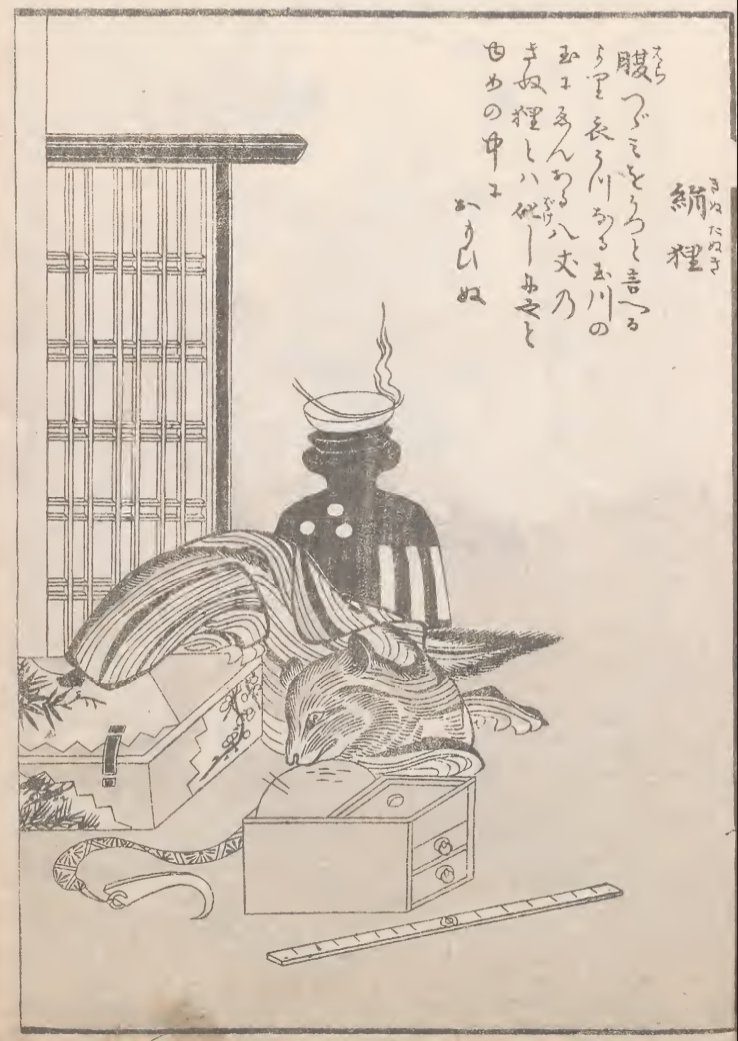
“Tanuki are usually described as beating their bellies like drums, which reminds me of beating laundry on the banks of the Tama river. The tama [jewel] of which reminds me of the “family jewels” of a tanuki, transformed into hachijo [eight spans of] Kinu [silk]. So I dreamed” - [Japandemonium illustrated 2017]
• Tanuki Puns Galore in this entry! - The Tama river is a major river which flows through Tokyo, The word “Tama” (玉) means “jewel” as well as “ball” in Japanese. Coincidentally, both these words can be used to refer to male genitalia in Japanese just as they can be in English. And if you know tanuki you are probably well aware of their fabled shapeshifting scrotums. (I have friends from Japan who are equally as baffled about the tanuki’s magic sack as many Westerners but, in a nutshell, this bit of folklore stems from artisans using that particular part of the tanuki’s stretchy skin to pound out gold leaf in ancient times.) Tanuki are often said to be able to stretch their balls out to the size of 8 tatami mats. Tatami mats are straw mats used in floors in traditional Japanese buildings. They’re also commonly used colloquially as a measurement. A single tatami mat is about 0.9 by 1.8 metres or 6 x 3 feet. 8 tatami mats is a typical room size and is called “hachi-jo” in Japanese. “Hachijo kinu” is 8 tatami mats worth of silk and also a famous brand of silk crafted on the Hachijo Islands. (More about that below.)
A “kinuta” is an old style wooden laundry mallet & table which is specifically used for beating softness back into cloth, as well as rolling laundry flat (kinda like an iron, but shaped like half a rolling pin or a mallet). The word “kinuta” was often used in old poetry to describe the wooden sound which it makes! (There's even a famous Noh play by Zenami, wherein a Kinuta would be struck for musical accompaniment!)
The yokai’s name in itself, “Kinutanuki” is ultimately a punny combination of all of the above points, which also creates a satisfying palindrome in Japanese so no matter which direction you read it, it still spells out “Kinutanuki” - “き(ki) ぬ(nu) た(ta) ぬ(nu) き(ki)” - (You can really tell that Sekien was having fun with punny wordplay here!)
• What matter of monster is it?: "Gazu Hyakki Tsurezure Bokuro" is a bestiary about Tsukumogami, That is to say, antiques that have become yokai over time. So, it seems pretty clear to me, that Kinutanuki are supposed to be bolts of forgotten fabric, which after ‘100 or so years of neglect’ gained a soul, got up and took on the guise of a Tanuki! .... However, as this yokai is typically only ever brought up when the question is asked - “Is this Yokai actually a Tanuki or is it actually a living fabric roll?” - You could say that perhaps that question in of itself is intricately part of this yokais lore! - The answer is always ever vague at best (and purposefully so.)
–so in the spirit of that; Against my own previous points, I’d suppose its also fair to say that Tanuki are indeed, that good at transforming into or mimicking objects: There are plenty of stories about tanuki that transform into cotton balls & other fabrics as well. (See also: Ashimagari) As well as the very famous story of ‘Bunbuku Chagama’ where the tanuki becomes stuck in the form of a kettle, permanently. (see also: Bunbuku Chagama) So, I digress, I’d suppose that both and neither could be true at once, simultaneously. Truly kinutanuki is Schrodinger's Tanuki! It is between the question, constantly! (...all Jokes aside; ultimately, This yokai is an excellent example of Toriyama Sekien’s brilliant punny word-play, at its finest!)
Yet another theory which was presented by famed researcher, Shigeru Mizuki; was that Kinutanuki are perhaps intended to be closer to audio phenomena! – They are Tanuki disguised in silk, which make the sound of clothing being beaten with a Kinuta; but, when you look go looking for the source of the noise, you find nothing. - [Very Similar to one of the seven Mysteries of Honjo; Tanuki Bayashi]
Incidentally, this one being on the opposite page to the ‘Bakenokawa-goromo’ (A Kitsunes Disguise-Garb) most definitely isn't a coincidence either! Tanuki and Kitsune are often said to be rivals at shapeshifting!
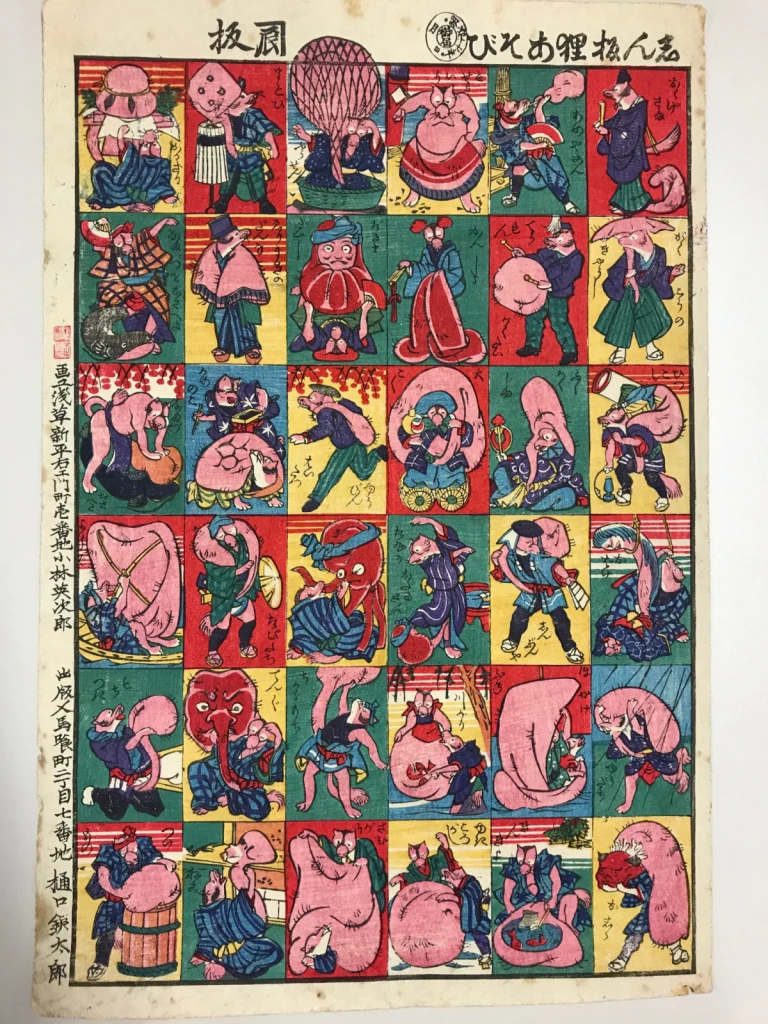
[Tanuki shape shifting their testicles into various objects, edo period print.]
• The Antiques in Question: Hachijo silk is a fine silk-fabric generally used for top of the line kimonos, it’s famously produced on hachijo-jima (part of the Izu island peninsula) The cloth is usually dyed naturally with local, plant-based dyes. Folklore has it that the golden-yellow color & patterns were protective wards against disease & that it could help keep evil spirits away! (see my section on charms for some similar folkloric concepts.) For a while throughout the Edo period, this silk was seen as so valuable that it was accepted as payment for land taxes in place of the usual yield of crops! At first the cloth was used for high quality clothing for imperial royalty, nobles, doctors and aristocrats, but as time went on it grew popular among common folk & eventually came to be used in everyday wear. In any case, it would have certainly been seen as a big deal to waste something so fine! No wonder the unused bolt became a Tsukumogami!
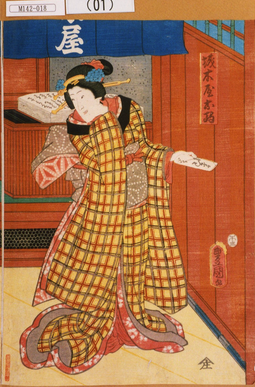
[above: a ukiyoe print of a woman in a Hachijo-kimono: image source] -
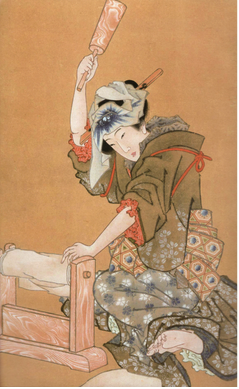
[Below: Right a woman beats cloth using a Kinuta (laundry mallet)]
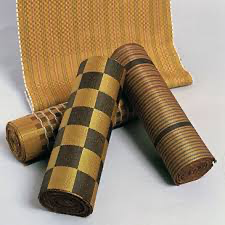
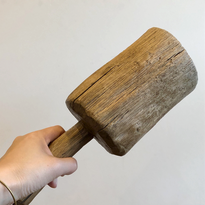
[various patterns of hachijo silk. - image source.] [A wooden kinuta. Image source ]
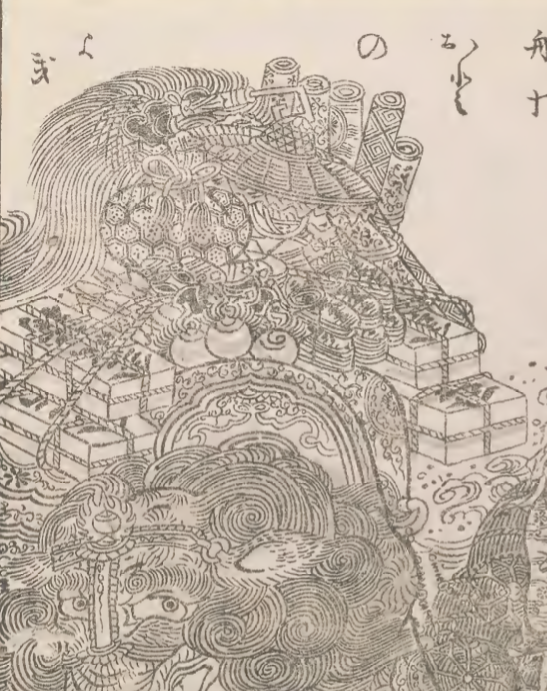
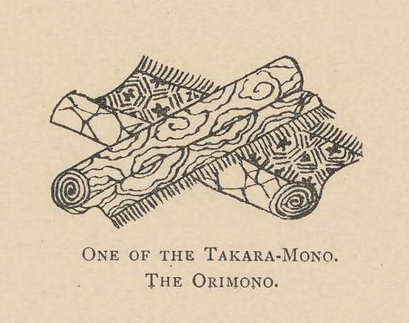
…also I can't help but point out that there’s perhaps also a nod towards the Shichifukujin (lucky gods) here as well? - Or perhaps, rather that Kinutanuki as a concept might take some inspiration from the ‘Takaramono’ (The magical/valuable treasures which the Shichifukujin bring aboard their ship for new years.) - I mention this as On the first and final few pages of Gazu Hyakki Tsurezure Bukuro where at the start of the book the Shichifukujin are seen asleep, and by the end of the series they’re all awake; among the other takaramono (treasures/”precious things”) several rolls of fabric are seen being carried on the back of an Elephant, which is being led by Daikoku & Ebisu. (The text on said page implies that they’re being loaded aboard the Shichifukujin’s Treasure Boat! (See: “Takarabune”) in particular, These valuable rolls of luxurious silk are often called the “Orimono” or “Rolls of Brocade” and are said to be symbolic of the nobles, and thus, luxury – as I’ve already explained above, hachijo silk was favored by the nobles for some time! So, I suppose it stands to reason that Golden Hachijo silk could also be among this collection of valuable fabrics as well! – (If not a direct reference, it at least feels like a nod towards the scene at the end of the book.)

[Art sticker & Writing by @SamKalensky (yo, thats me!) Editing by @Cattype. Part of my Hyakki Yagyo Night Parade of 100 yokai sticker series. Follow & check my shop out for many more!]