
![Bakenokawa-goromo - [Kitsune|Tsukumogami]](https://samkalensky.com/wp-content/uploads/2026/03/IMG_4949-scaled.jpeg)
![Bakenokawa-goromo - [Kitsune|Tsukumogami] - Image 2](https://samkalensky.com/wp-content/uploads/2026/03/IMG_4957-scaled.jpeg)
![Bakenokawa-goromo - [Kitsune|Tsukumogami] - Image 3](https://samkalensky.com/wp-content/uploads/2026/03/IMG_4952-scaled.jpeg)
![Bakenokawa-goromo - [Kitsune|Tsukumogami] - Image 5](https://samkalensky.com/wp-content/uploads/2026/03/IMG_4968-scaled.jpeg)
![Bakenokawa-goromo - [Kitsune|Tsukumogami] - Image 6](https://samkalensky.com/wp-content/uploads/2026/03/IMG_4958-scaled.jpeg)
Description
Bakenokawa-goromo – [Yokai|Kitsune|Tsukumogami] – ばけの皮衣. – “Disguise garb”
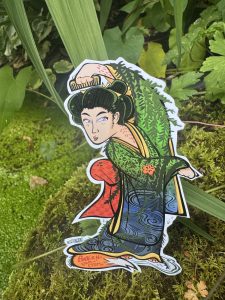
• About this Yokai: An enchanted water-moss duck-weed overcoat which was once worn by the most nefarious of Kitsune; Lady duckweed! (Aka: Tamama-no-mae.) … Perhaps, now 3000 years after her defeat, the precious jade duckweed she wore, now as a tsukumogami, takes on her shape and beautiful appearance ?
• Origin: Bakenokawa-goromo is likely another Tsukumogami first named and illustrated in Toriyama Sekiens “Gazu Hyakki Tsurezure Bokuro” [1784.] – The image depicts what appears to be a kitsune, half transformed into a human-woman (but you can tell shes a fox because of her hairy neck, tail and paws.) she’s wearing an ornate kimono with water-moss draped over her arms, she has a comb in hand. The palanquin behind her (also called a “litter”) & is reminiscent of the kind that High ranking courtesans called ‘Ooku’ would be carried around in. (presumably it would be carried by the workers depicted leaning over the carriage behind her.) – she is clearly Kitsune royalty! – Toriyama’s entry goes as follows:
“The Old Chinese tales about a three thousand year old fox who draped itself in water-moss and prayed to the north star to shape-shift into a beautiful woman must refer to this. So I dreamed.” – [Japandemonium illustrated. 2017]
Indeed; This description refers to the legendary kitsune, “Tamama-no-mae.” – [A legendary evil kitsune who came close to taking over all of India, China, and Japan. (only to have her plots foiled at the last minute each time!) She was eventually defeated via an arrow shot by Minamoto samurai, Miura-no-suke & Kazusa-no-suke, and she was then sealed in the Sessho-seki. (A real stone, which broke in half just a couple of years ago!) – [More about her story and that event over here.] Tamamo-no-mae also often went by the alias “lady duckweed” or “Beautiful water-moss” – in time, Tamamo (玉藻) in turn became slang, another word for the elegant dresses worn by courtesan ladies or for extremely beautiful courtesans themselves.
…According to 9th century texts such as “酉陽雑俎” around the age of 100, Kitsune begin to worship the big dipper; (Wicked Kitsune at this rank are usually called 地狐 (“Chiko.”) and are said to disguise themselves by wearing a skull (or a lotus leaf) over their heads, covering their bodies in duckweed and then praying to the big dipper. (Or bowing towards the North Star.) As long as the disguise stays in place, their disguise will remain…
As this entry is included in “Gazu Hyakki Tsurezure Bokuro” which mainly focuses on Tsukumogami, The entry in itself is in all likeliness more-so referring to her disguise, personified! So, Rather than this being Tamamo-no-mae herself; after being worn for so long, perhaps the duckweed has come to life and taken her form?
As with the silken, Kinu-tanuki (which appears on the opposite page!) it feels to me that the two where likely included as another ‘Takaramono’ nod, a second yokai representing The “Orimono” or “Rolls of Brocade” which are said to be symbolic of the nobles, and thus, luxury; so with that alternate meaning of Tomamo in mind, the ‘kitsunes 3000 year old garb that they used to transform’ paired with the ‘Tanuki disguised as a bolt of fine silk’ together being tsukumogami representing these Orimono makes enough sense to me at least!! Tomamo-no-mae’s whole thing was tricking people, and that was largely in thanks to the moss/clothing she wore~
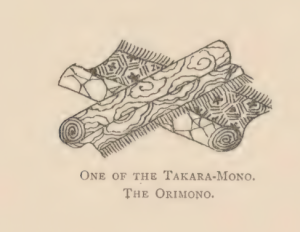
A few other Tsukumogami which might have be inspired by the takaramono include: Kinutanuki, Fukuro-Mujina, Kyorinrin, Minowaraji. – Of course, The Lucky gods, (Shichifukujin) appear themselves at the start and the end of the book with all of their treasures in tow!
— But of course, that’s just a theory; Kitsune disguising themselves as beautiful human woman is a fairly common folkloric trope with variants found all across Japan…
I know what you’re thinking! – “With so many Kitsune in disguise as humans, it sure would be nice to have someway to identify them.” One such method to see through a yokai’s disguise was described and illustrated in 1819 called 狐の窓, “Kitsune-no-mado” or “The foxes window” —According to the National Diet Library:
“The Fox’s Window” was supposedly a magical hand sign or charm that would allow one to uncover the true nature of a monster by peering through the gaps between one’s fingers”
Kitsune-no-mado as it appeared in [“新版化物念代記” 1819]
[How to do Kitsune no Mado: in step ①, both hands are shaped like a fox; in step ②, they are interlaced alternately; in step ③, the fingers are spread apart; and in step ④, the spread fingers are held down by the thumbs. – [see also: ‘folklore of gestures’ (2006)しぐさの民俗学]
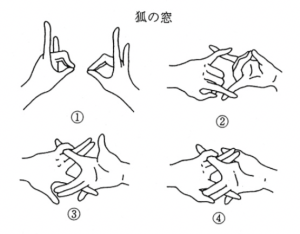
— I suppose that You could think of it a bit like a “Lens of Truth!” Its stupid hard to pull off (which I suppose, Is more or less the point.) Most historians consider it part of traditional folklore rather than a literal practice. (its only a couple hundred years old afterall & Regardless, I feel like you would have been eaten by a yokai by the time you actually managed to use it!) I digress; Today, Tamamo-no-mae and this technique both appear in quite a few anime and manga
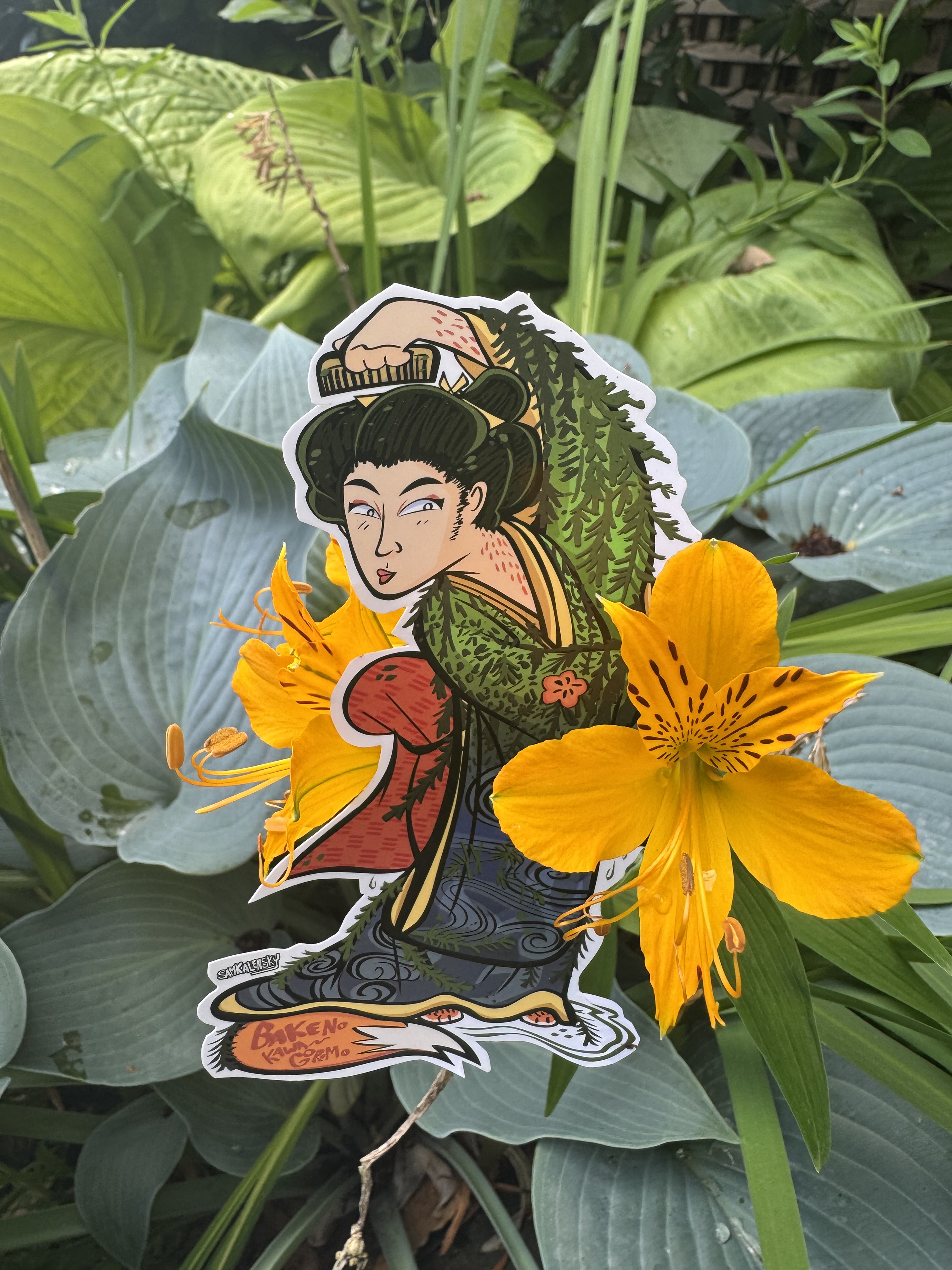
[art sticker by samkalensky (yo, thats me!) part of my Kitsune & yokai series of stickers support and follow for many more!]
![Kura yarō - [Yokai|Tsukumogami]](https://samkalensky.com/wp-content/uploads/2026/03/samkalensky-39mMqRmo61ETD7voeRmaz-6D2944B3-3190-45C2-B60B-E6859E1EE236-324x324.jpg)
![Gotoku neko - [Yokai]](https://samkalensky.com/wp-content/uploads/2026/03/samkalensky-qu-AhW46IgFA2Zp5PYz7l-04816A3B-C857-428A-B48C-5C6AD31E0873-324x324.jpg)
![Furu-utsubo - 古空穂 - [Yokai|Tsukumogami]](https://samkalensky.com/wp-content/uploads/2026/03/53D26373-7997-4484-9849-51C06AEF9774-324x324.jpg)
![Bakenokawa-goromo - [Kitsune|Tsukumogami]](https://samkalensky.com/wp-content/uploads/2026/03/IMG_4949-324x324.jpeg)
Reviews
There are no reviews yet.