
![Suzuri-no-tamashii - 硯の魂- [Yokai|Tsukumogami]](https://samkalensky.com/wp-content/uploads/2026/05/IMG_4448-scaled.jpeg)
![Suzuri-no-tamashii - 硯の魂- [Yokai|Tsukumogami] - Image 2](https://samkalensky.com/wp-content/uploads/2026/05/IMG_4434-scaled.jpeg)
![Suzuri-no-tamashii - 硯の魂- [Yokai|Tsukumogami] - Image 3](https://samkalensky.com/wp-content/uploads/2026/05/IMG_4428-scaled.jpeg)
![Suzuri-no-tamashii - 硯の魂- [Yokai|Tsukumogami] - Image 4](https://samkalensky.com/wp-content/uploads/2026/05/IMG_4430-scaled.jpeg)
![Suzuri-no-tamashii - 硯の魂- [Yokai|Tsukumogami] - Image 5](https://samkalensky.com/wp-content/uploads/2026/05/IMG_4431-scaled.jpeg)
![Suzuri-no-tamashii - 硯の魂- [Yokai|Tsukumogami] - Image 6](https://samkalensky.com/wp-content/uploads/2026/05/IMG_4432-scaled.jpeg)
![Suzuri-no-tamashii - 硯の魂- [Yokai|Tsukumogami] - Image 7](https://samkalensky.com/wp-content/uploads/2026/05/IMG_4434-1-scaled.jpeg)
![Suzuri-no-tamashii - 硯の魂- [Yokai|Tsukumogami] - Image 8](https://samkalensky.com/wp-content/uploads/2026/05/IMG_4450-scaled.jpeg)
![Suzuri-no-tamashii - 硯の魂- [Yokai|Tsukumogami] - Image 9](https://samkalensky.com/wp-content/uploads/2026/05/IMG_4434-2-scaled.jpeg)
Description
Suzuri no Tamashii – 硯の魂 – [Yokai | Tsukumogami] – aka: “Inkstone spirit” or “The Haunted Inkstone”
• About this Yokai: An antiquated & well used, top-quality ink stone that was produced in Akamagaseki what is today known as Shimonoseki, Ube City, Yamaguchi Prefecture. One day, the owner of the ink stone dozed off while reading the epic “The Tale of Heikei.” As he lay there, waves of ink surged up from the stone like an ocean and tiny scribbles of samurai began to play out the battle of Dan-no-Ura. This stone was either possessed by the grudge of the spirits who died during that epic clash or perhaps by the talents of the calligrapher who copied the tales manuscript countless times…
• History & earliest appearances: This yokai made its earliest illustrated & first named appearance in Toriyama Sekien’s “Hyakki Yagyo Shui” (1780). The illustration depicts an ink stone overflowing with ink and several tiny soldiers battling in a scene just like in the Genpei War. Specifically the climactic battle of “Dan-no-ura.” – The climactic clash of the civil war between the Taira (Heike) and Minamoto (Genji) clans. The war lasted from 1180–1185. By Sekien’s time these battles had become the subject of pop culture with dozens of re-enactments in both kabuki and noh theater! The battle of Dan-No-Ura which took place in the straights of Shimonoseki, is famously retold in the “Tale of Heike.” The entire Taira clan and the young emperor Antoku met their end in that battle. Their ships sunk and the young emperor (who was only 5!) drowned with most of his men following him to the watery grave. And thus, the clan’s spirits are said to still haunt the straight to this day.
Toriyama’s entry for this yokai goes as follow:
“A certain man had a fondness for the Aka-maga-seki ink stone in his writing room. One day he dozed off while reading The Tale of Heike. An ocean appeared in his ink-stone and the Genji and the Heike began battling before his eyes. This recalls the Chinese story of Xu Xuanzhi and the ink stone pond” – [translation: Japandemonium Illustrated 2017]

The mentioned legend of ‘Xu Xuanzhi and the Inkstone pond’ as far I’m aware, is actually a Chinese folktale about a young man who tries to become the best calligrapher in all of China. He practiced writing every day, repeatedly washing his brush in a pond. The does this so often that the entire pond becomes black as ink! The boy grows up to become the famous “Sage of Calligraphy.” The story is about repetition, practice and being rewarded for your perseverance. it was no doubt well known in Sekien’s time. In 978, the real Xu Xhanzhi apparently also contributed to a book called “Taiping Guangji” which contains over 7000 supernatural tales from China, A famous one involves a man awakening into a tiny kingdom which turns out to be an anthill under his porch.
• The artifact in question: Since the Kamakura period (1185-1333) and well through the Edo period (when Toriyama was active) Shimonoseki has become known as the place where high quality Akama Suzuri, ink stones (Ink pallets, really.) were quarried and made by hand. They are still produced there to this very day! These artisan stones are prized for their smoothness and are favoured by calligraphers & artists who use brushes for their work! One of these stones was even presented to the first shogun, Minamoto no Yoritomo (Who’s younger sibling, Yoshitsune was famously directly involved in the mentioned Dan-no-ura conflict.)

[A famous scene from Dan-no-Ura. Minamoto no Yoshitsune flies through the air during his famous eight boat leap as his enemies sink into the sea. Print by Yoshitoshi 1880.]
So, in a nutshell, the idea behind this yokai is that because this ink stone came from Shimonoseki and the Shimonoseki Straight is also where the Taira clan met their end in battle, then perhaps the inkstone itself could also have been possessed by the grudge of the Taira clan! (or the waters where they died; somewhat like the heikeigani crabs) Alternatively, and a perhaps a bit more aptly, the stone is haunted by the epic tale itself after the inkstone was used to rewrite the same tale so often. It then eventually came to life as a tsukumogami! (Incidentally, this isn’t the only time a tsukumogami that came to life because of an artist’s talents. This seems to be an ongoing theme with certain tsukumogami, especially those related to the arts & performances. See the Similar and Related Yokai section below for more about that.)
[An example of a hand made akama inkstone (and a very cute inkstone shaped onomori charm!) image source]
I also can’t help but wonder if the “certain man” mentioned by Toriyama is meant to be Toriyama himself. Perhaps he’s giving props to his own inkstone? In his works, he certainly showed love for the Tale of Heike. Several of his yokai are direct references to the Genpei War as well as the stories and figures relating to it! (These yokai include: Mekurabe, Nue, Kurayaro, AbumiGuchi, FuruUtsubo, Mukumukabaki, and a few others!)
One final tangent: When I was a young artist, I was also trained to use an ink stone amoung other tools for inking my comics and animation work when I was just beginning. But I eventually felt it was too messy & wasteful to use these too often so I eventually turned to full-time digital with a tablet. I still do my sketches in pencil or ink from time to time, but its rarely done “professionally.” I use a cintiq pen and tablet much more often these days. One can’t help but worry a bit that with the efficiency of digital tools something might become lost as society becomes more and more reliant on them. There’s a certain ‘looseness’ to traditional art & there are skills that one can only develop through trial and error with pen and ink. Learning to ‘fail fast’ without remorse & knowing when to stop are also both very important skills to learn. I’d encourage young artists to pick up a brush and train yourself to do traditional techniques. Finish at least 500 pieces you’re satisfied with & bring what traditional skills you’ve learned into the digital setting. This is how I developed my style and why I’m less afraid of being messy (especially when doing digital art, where mess costs nothing!) If you want to loosen up, I’d also recommend trying 30 second gesture poses! (pose maniacs is excellent for that!) Draw about 10 poses per day for a few months and you’ll be on your way in no time.
…Anyway! I digress, it is pretty fun that no matter the era, when, or wherever you are, artists sure love the idea of their work literally jumping out of the inkwell, onto the page and coming to life!
Similar and Related Yokai: Here’s more examples of tsukumogami stories in which a performer’s talent or skill rubs off on the item and it comes to life.
- Menreiki – A collection of noh theatre masks which were said to have been enchanted by the actors performances and were said to speak to each other at night.
- Yoro-no-gakuya – Puppets used in bunraku productions of 47 Ronin that where possessed by the actors’ talents and come to life to fight each other after midnight!
- Biwaboku – A particular top of the line wooden biwa that once belonged to a blind monk. Abandoned after the monk’s death, it copied his form and wandered blindly as a zato beggar. (Biwa-obake are fairly commonplace in older illustrations as well and are said to come to life when the owner doesn’t practice!)
- Shamichoro – a sorrowful shamisen that used to belong to a master musician. But when the master retired it was only played by novices from then on out. As such, came to life as a yokai, lamenting what once was.
- Kotofurunushi – is a wild floor-harp which turns into a fearsome draconic yokai! The anthropomorphic grudge of forgotten music seeks revenge!
Here’s some of the other yokai Toriyama drew in reference to “The Tale of Heike” & other events surrounding the Genpei war:
-
Mekurabe – An uncountable pile of skulls that haunted the Taira clan’s most ruthless warlord Taira No Kiyomori
-
Nue – A chimerical beast that appeared above the capital in a lightning strike. It haunted Emperor Niji and made him ill until it was defeated by Minamoto no Yorimasa.
-
Kurayaro – A Haunted saddle that sings a dirge about how it belonged to a fallen Minamoto clan warrior.
-
AbumiGuchi – Haunted saddle stirrups that also sing about how they belonged to a fallen Minamoto clan warrior.
-
Mukumukabaki – The haunted riding chaps belonging to a nobleman who was the uncle of the famous Shoga brothers who would eventually assassinate Minamoto no Yoritomo. A story known as one of Japan’s “big 3 vendettas”
-
FuruUtsubo – The haunted arrow quiver owned by legendary archer & Minamoto general Mirua Yoshiaki. It was this quiver that fatally shot the famous evil kitsune Tamamo no Mae
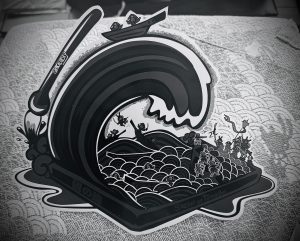 [Art sticker & Writing by @SamKalensky (yo, thats me!) Editing by @Cattype. (I’m also here.) Part of my Hyakki Yagyo Night Parade of 100 yokai sticker series! Follow & check my shop out for many more!]
![Abumi guchi - [Yokai|Tsukumogami]](https://samkalensky.com/wp-content/uploads/2026/03/21FF3F30-C4B0-493A-811D-17D7510E6D05-324x324.jpg)
![Choku-boron - [Yokai|Tsukumogami]](https://samkalensky.com/wp-content/uploads/2026/03/IMG_3223-324x324.jpeg)
![Koroka - 古籠火 - [yokai]](https://samkalensky.com/wp-content/uploads/2026/03/Screenshot-2026-09-13-at-10.02.16-AM-324x324.png)
![Suzuri-no-tamashii - 硯の魂- [Yokai|Tsukumogami]](https://samkalensky.com/wp-content/uploads/2026/05/IMG_4448-324x324.jpeg)
Reviews
There are no reviews yet.