
![Onigawara - [Yokai | Charm]](https://samkalensky.com/wp-content/uploads/2026/10/IMG_6619-scaled.jpeg)
![Onigawara - [Yokai | Charm] - Image 2](https://samkalensky.com/wp-content/uploads/2026/10/IMG_6638-scaled.jpeg)
![Onigawara - [Yokai | Charm] - Image 3](https://samkalensky.com/wp-content/uploads/2026/10/IMG_6615-scaled.jpeg)
![Onigawara - [Yokai | Charm] - Image 4](https://samkalensky.com/wp-content/uploads/2026/10/IMG_6618-scaled.jpeg)
![Onigawara - [Yokai | Charm] - Image 5](https://samkalensky.com/wp-content/uploads/2026/10/IMG_6632-scaled.jpeg)
![Onigawara - [Yokai | Charm] - Image 6](https://samkalensky.com/wp-content/uploads/2026/10/IMG_6621-scaled.jpeg)
Description
Oni-gawara – 鬼瓦 – [Yokai|Charm] – “Demon-Ogre Tiles”
• About: Decorative Apotropaic Clay Roof Tiles which are hand-sculpted to look like a grimacing “Oni” -(a large variety of other patterns & designs exist too, includng flowers clouds and family crests, but to stick with the theme; we’ll focus on the Oni.)- Much like Sachihoko, which adorn castle rooftops and are said to prevent fires, Onigawara are often placed to sit at an angle along the ridge end-caps of tiled temple roofs! (They appear to be leering downwards, menacingly, as though they’re about to pounce at you!) You’ll often see tiles like these decorating the roof tops of Buddhist temples, castles and (rarely) homes too! These tiles are placed as decorative amulets and are said to guard against evil & ward away misfortune!
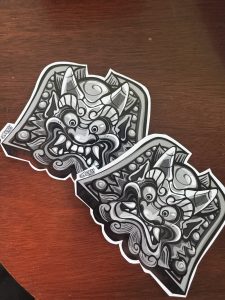
Much like Komainu, Shisa, Niō and other ‘guardian statues’ like them, the face with the mouth open is called A-gyō (阿形) “Ah” , representing Yang, life and beginnings. – The one with a closed mouth is called Ungyō (吽形) “Un” representing Yin, death and the end. – Together these represent the Japanese-Buddhist “Om” (阿吽) – A syllable which symbolizes the beginning, middle, and end of all things. (its Sanskrit in origin, often used in meditative chants the world over.) Statues that are paired like this are said to be in an “A-Un” relationship’ “阿吽の仲” (or “a-un no naka”)
You’ll often find Onigawara in pairs on either end of a rooftop, with one side showing an open mouth and another side showing a closed mouth. – In the case of orientation, Onigawara tiles are typically placed with the open mouth on the right and the closed mouth on the left. – The orientation might vary in different places, Some are stacked with the open mouth on the top ridge and the closed mouth on the corresponding lower ridges (others mix it up and place multiple tiles along the ridge, as seen in the JAANUS diorama below.)
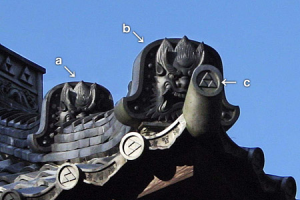
In any case; If you were to make or hang your own Onigawara it is most useful to hang them over entry ways, as it supposedly blocks evil spirits from entering your house! – [just for fun, you can find A full walk-through on how to craft your own out of clay, here!]
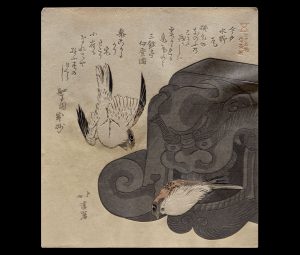
From the title the above print is about “Mizuno in Imado” (current day Asakusa, Tokyo) which was famously known for its OniGawara craftmenship at the time! The print depicts two Sparrows nesting in the mouth of an Onigawara. No doubt the bird in the mouth is meant to look like its being eaten with the other coming to its rescue! Incidentally, this print brings to my mind: “Onihitokuchi” from Toriyama Sekiens “Konjaku hyakki shui” [1780] i cant help but wonder if that was intentional or not…
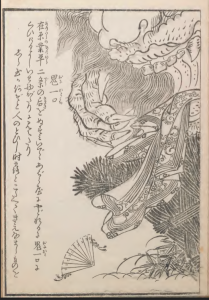
Perhaps its because of the odd angle onigawara are placed it feels like they’re about to pounce down onto you! (brings to mind the yokai Tsurube-otoshi.) – Its quite likely that this intimidating aura that they inspired the “THWOMP” enemies from Nintendo’s Super Mario series. – In Super Mario Odyssey, this association is especially clear! their appearance literally even looks just like an Oni!
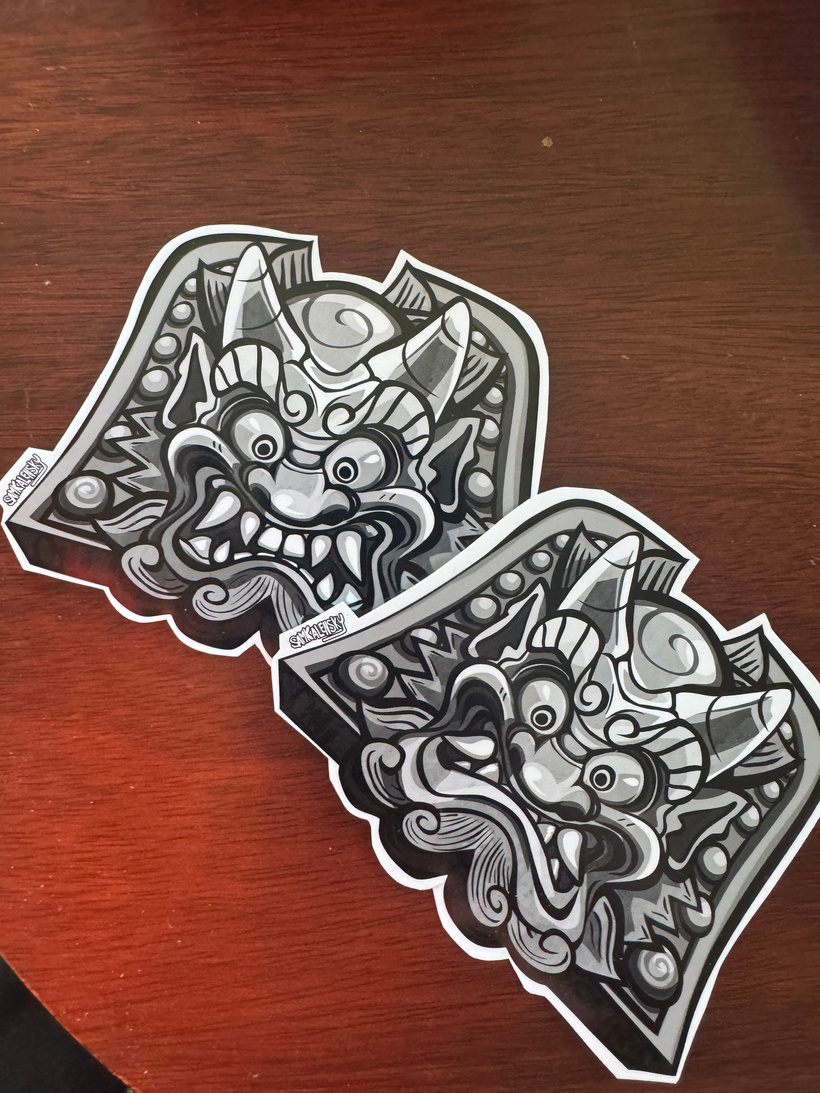
[Art stickers by @samkalensky (yo, thats me!) part of my Yokai and charms collection!]
Reviews
There are no reviews yet.