
![Limmertakus Boottii - "Wamfahoofus" - [Fearsome Critter]](https://samkalensky.com/wp-content/uploads/2026/03/img_5155-1-scaled.jpeg)
![Limmertakus Boottii - "Wamfahoofus" - [Fearsome Critter] - Image 2](https://samkalensky.com/wp-content/uploads/2026/03/img_5165-1-scaled.jpeg)
![Limmertakus Boottii - "Wamfahoofus" - [Fearsome Critter] - Image 3](https://samkalensky.com/wp-content/uploads/2026/03/img_5163-1-scaled.jpeg)
![Limmertakus Boottii - "Wamfahoofus" - [Fearsome Critter] - Image 4](https://samkalensky.com/wp-content/uploads/2026/03/img_5158-1-scaled.jpeg)
![Limmertakus Boottii - "Wamfahoofus" - [Fearsome Critter] - Image 5](https://samkalensky.com/wp-content/uploads/2026/03/img_5153-scaled.jpeg)
![Limmertakus Boottii - "Wamfahoofus" - [Fearsome Critter] - Image 6](https://samkalensky.com/wp-content/uploads/2026/03/img_5152-1-scaled.jpeg)
![Limmertakus Boottii - "Wamfahoofus" - [Fearsome Critter] - Image 7](https://samkalensky.com/wp-content/uploads/2026/03/img_5173-scaled.jpeg)
![Limmertakus Boottii - "Wamfahoofus" - [Fearsome Critter] - Image 8](https://samkalensky.com/wp-content/uploads/2026/03/img_5168-scaled.jpeg)
![Limmertakus Boottii - "Wamfahoofus" - [Fearsome Critter] - Image 9](https://samkalensky.com/wp-content/uploads/2026/03/img_5172-scaled.jpeg)
![Limmertakus Boottii - "Wamfahoofus" - [Fearsome Critter] - Image 10](https://samkalensky.com/wp-content/uploads/2026/03/img_5171-scaled.jpeg)
![Limmertakus Boottii - "Wamfahoofus" - [Fearsome Critter] - Image 11](https://samkalensky.com/wp-content/uploads/2026/03/img_5159-scaled.jpeg)
![Limmertakus Boottii - "Wamfahoofus" - [Fearsome Critter] - Image 12](https://samkalensky.com/wp-content/uploads/2026/03/img_5175-scaled.jpeg)
![Limmertakus Boottii - "Wamfahoofus" - [Fearsome Critter] - Image 13](https://samkalensky.com/wp-content/uploads/2026/03/img_5157-scaled.jpeg)
Description
Limmertakus Boottii – [Fearsome Critter] – (Latin name: Limmertakus boottii.) – Aka: “Wamfahoopus”, “Wampahoofus'”or “”Wamfahoofus.”*
• About this critter: A flat creature, shaped something like a lily pad, with the consistency & colour of leathery pond-scum; it has at least one frog like eye which looks a bit like a bubble, It hides unseen, anchored slightly below the surface of puddles & shallow wet spots in boggy areas in the white mountains of New Hampshire, Maine, and along the trails of the Appalachian Mountains. It appears shortly after rainfall & will steal the boots right off your feet! It feeds on boot leather (but it will settle for sneakers too!) Smart scouts and hikers know to listen to superstition and keep to the left side of any puddle when traversing the mountain range; as the creature waits for someone to step on it, it will reach out with its one single right arm and hold on tight in an attempt to pull their leg! – If one is successful in escaping with their foot gear, usually you would hear a long, mournful wail; “schckckcklooop.” (The sound of a very hungry Limmertakus.) – Supposedly; It was first described in personal letters by Pioneer, Dr Francis Boott (1792–1863) the botanist of whom Boott spur peak is named after.
[*Though it is often called by a near identical name and exists in the same white mountain range, the Limmertakus, should probably not be further conflated with the ‘Wampahoofus‘ a Side Hill Gouger variant of the nearby Mt.Mansfield Vermont. More about that below!]
• History: The earliest written mention of the critter which i could find, was earliest described by A.J.Oxton; A Hike leader (most active in the 70’s) who described telling the Limmertakus story to his scouts; an entry on his website’s blog “Once in a blue moon” goes as follows:
“…I have spread fear into the hearts of many kids as we lunched at Dingmaul Rock on the upper slopes of Mount Jefferson, tracked the Side Hill Gouger on Mount Chocorua, and rescued more than one victim of the Wamfahoofus.
Limmertakus boottii, commonly known as the Wamfahoofus, was first described by Dr. Francis Boott (1792–1863), after whom a minor peak southeast of Mount Washington is named.
L. boottii is shaped somewhat like a leathery lily pad in a pond, with eyes like a frog—oftentimes only one eye, looks like a bubble—the Wamfahoofus waits in puddles, shallow wet spots, low boggy areas, along the trails of the Appalachian Mountains. The Wamfahoofus feeds on boot leather but will often be fooled into taking a sneaker as well. They have only a right hand and wait for the unwary hiker to step on them when trodding through their puddle whereupon the Wamfahoofus grabs on tight. If you are successful in escaping with your foot gear usually you will hear a long mournful wail, a schckckcklooop kind of sound, the cry of a hungry Wamfahoofus. Best avoided by keeping to the left of any puddles you encounter…”
Later on, in 2013, it seems that the Limmertakus bootii was first labelled as a ‘Fearsome Critter’ in a New York Forest Owners Association Newsletter, which in addittion to the above also notes –
“This account was submitted by A. J. Oxton of the White Mountains of New Hampshire. From original research, along with the anecdotal accounts of hikers, such as local historian Ben English, and others he met along the Way. Limmertakus boottii was first described by Dr. Francis Boott (1792-1863), after whom a minorpeak southeast of Mount Washington is named. Dr. Boott never wrote his description of Limmertakus boottii beyond comments in a few personal letters; he greatly feared tarnishing his reputation, and his living as a botanist. For the most part the Legend of Limmertakus was passed down as a campfire story. The common name derived, later in part, from the sound a youthful sneaker makes when slammed with diligence into just the right consistency of mud.”
From there the article was more recently included in the ‘Lumber-woods unnatural history museum’s’ “Plaid Fairy Book” [ by Lenwood Sharpe, 2024] The creature has also since been included in “Mythical Creatures of Maine“ by Christopher Packard, 2021. – In Chris’s book he mentions that he devised a way to pick up the flat creatures using a fantastical tool he invented called the “Wamfahoopus Rod.”
…About a year ago, In 2025; I became curious to verify some facts surrounding this critter and its origins, and so I actually did some arm-chair field-work, I wrote to A.J.Oxton via email, who graciously; responded quite enthusiastically. Apparently, he had no clue about the critters inclusion in the 2013 newsletter or any of the other sources I’ve linked to thus far! – On his advice; I also reached out with further inquiries to the Mount Washington Observatory. – (as well as the mentioned historian/folklorist Ben English of NH whom I am sadly still waiting to hear back from as of posting! Perhaps he didn’t receive my letter.🤷) – The observatory’s curator (Pete C.) was kind enough to humour my request & verify some important information: Though, Quite sadly; They did not have any documents or personal letters relating to Dr. Boott… However, the observatory did point out that as Boott was a Botanist, naming a creature after a shoe “would be odd*” and also added that The Limmer boot (which has been very popular footwear in the White Mountains since the 1920’s) of which the creature is seemingly named after, did not appear on the scene until several decades after Francis Boott’s death in 1863. – So I’d suppose that Boott, having local relevance to the nearby Bootts Spur peak & being a botanist; and as the creature is described as “resembling a lillypad” perhaps makes the claim that he wrote about it ‘feel somewhat valid’; the issue is that Francis couldn’t have named the critter after a type of boot which did not exist until decades after his death! So; with that in mind, it feels far more likely that the opposite is true, the critter was named after the Botanist!!
[*As a side note: I’d argue that ‘naming a creature after a boot’ isn’t actually that far-fetched, there are plenty of stranger scientific namings out there; for instance; since its release in 1993, Scientists have named at least 17 several real life species after Pokemon. In 2000; Scientists also began to refer to vanishing chemical particles as “Chemical Squonks” after the famous vanishing fearsome critter of the same name. ETC, the list of scientific absurdities goes on…]
Alas, a full year later, I’m still not anywhere close to finding that letter! At this point I must point out that it is quite likely that it is likely that perhaps, once again i’m ‘chasing snipes‘; it seems likely that Boott did not name the critter. But rather perhaps he vaguely described it once? I’d assume that if the letter is ‘real’, said letter likely either describes a creature (or perhaps just a mud puddle) taking his boot, (something more mundane than him describing an undiscovered creature.) Others likely named/exaggerated it over time. – Unless by some miracle bootts ‘personal letters’ in question actually do show up someday, this factoid will sadly remain unverified! – To those that are reading this and perhaps still hunger for the truth? – Several of Dr. Bootts writings are in fact available online! – [I’ve searched through them but I’m personally not super inclined to go reading through what is likely several hundreds of letters which are all written in Old-English-cursive! if that’s your thing, good luck! and if you do find anything, please let me know! I’ll be sure to update this article with whatever is found!!] – However, I should also note, as of writing, I’m unsure if the specific letters mentioned by Oxton are available at the sources of which I’ve linked so far, said letter might not even be digitized? – Good luck finding it!!
Ultimately, the Limmertakus seems to be yet another critter which seemingly originates with the local scouts, the story potentially dates back a bit further orally than the sources i’ve listed thus far; Notably & somewhat Interestingly; Limmertakus bootii is in fact, not the only critter which was said to steal boots from hikers! – There’s at least one other critter from the New England area which dates back to at least the 1980’s known as ‘The Bootshuck’ (latin name: podinudiator shuccus) This ‘Bootshuck’ is apparently a tiny imp-like creature that will hide in mud, grab and pull the boot straight off your foot! for what purpose is not said, but apparently the best way to get your boot back from the quick-sand-like-mud and not get stuck yourself is by using a “clam-hoe!” – If there is more than one story about losing your boot to a critter that hide in puddles, located in the same area; then I’d assume its at least a pretty common peril!
 [illustration of the ‘Bootshuck’ from “Ghastly Perils of the great outdoors, a New England bestiary” by Peter Farrows [1986]
As my regular readers know, I’ve written about several of these ‘Scout Critters‘ before (see the ‘similar critters’ list at the bottom of the article.) – so, I’d like to end this section by mentioning that I’m certainly not writing all this out to debunk or invalidate the folklore of it. I believe strongly that whether its micro-folklore & regardless if they are ‘taken seriously’ (or not) these critters certainly have their own place in our contemporary folklore and mythology! So please!! DO continue to beware of the dangers presented and keep left of puddles when hiking in the mountains, lest your feet get wet & your socks muddied!
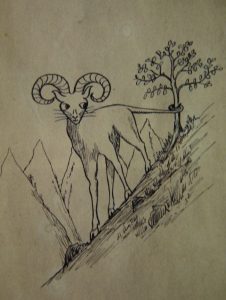
*About the ‘Wampahoofus’: Although they almost share the same general location (and an incredibly similar, popular name) this critter should not be further conflated with the variously described “Wampahoofus.” – The regions side hill gouger variant, which is best known in Vermont. – This gougers name comes from the very real “Wampahoofus trail” which is also in the white mountain range. [which is geologically very close to Boott Spurr!] – I’d suspect that the conflation came about when Henry H Tryon a wrote about the side hill gouger in his 1939 book Fearsome Critters [published 4 years after the trail was officially named!] – The creature is based on the location itself; after a few caves and oddly shaped rocks found along the trail: so as it often does, the ‘gouger’ variant stuck to folklore a bit better. – (Side Hill Gougers are best known for ‘walking around hill side’ and to avoid the Limmertakus, you ‘walk around the puddle.’ the source of the confusion is apparent enough.) – I digress, Supposedly the trail got its name from a rock formation which “resembled a Wampahoofus’ similar to the legend behind earlier mentioned dingmaul rock. –
“The Wampahoofus Trail on Mount Mansfield, Vermont’s highest peak. The trail, established in 1935 by the Long Trail Patrol of the Green Mountain Club, was named after a rock formation resembling the legendary beast. – The trail remains a popular hiking route, marked on official Long Trail maps and maintained by the Green Mountain Club… The characteristic rock formation that inspired the trail’s name can be found at coordinates: 44°31’33″N, 72°49’13″W.” – Timothy page. Vermont Daily Chronicale 2025.
[a photograph of the rock in question from Into the mountains, 1995]
[image Courtesy of Strange vermont]
[side hill gouger provided by A.J.Oxton]

• Some Similar critters: BeaverSharks, Snipes. Rumtifusel, Flat, Side-hill Gougers, Teakettler,
![Happy Auger - [Fearsome Critter]](https://samkalensky.com/wp-content/uploads/2026/03/samkalensky-0jADZwkFGUPpejUrzSGbg-52D01B81-A88B-485B-97B0-090C1BA3B291_1024x1024-2x-324x324.jpg)
![Wanigan - [Fearsome Critter]](https://samkalensky.com/wp-content/uploads/2026/03/samkalensky-cNpSyuuXN0yD_F-m92Y3m-8C8586D8-ACC0-4C6C-AB8A-7280E97B4E74-324x324.jpg)
![Barrum - [Fearsome Critter 🇨🇦]](https://samkalensky.com/wp-content/uploads/2026/03/samkalensky-Wga25dHt2z4e92D-vCJbV-3407017E-65BC-4554-899D-8F3B4B97ED90-1-324x324.jpg)
![Limmertakus Boottii - "Wamfahoofus" - [Fearsome Critter]](https://samkalensky.com/wp-content/uploads/2026/03/img_5155-1-324x324.jpeg)
Reviews
There are no reviews yet.